
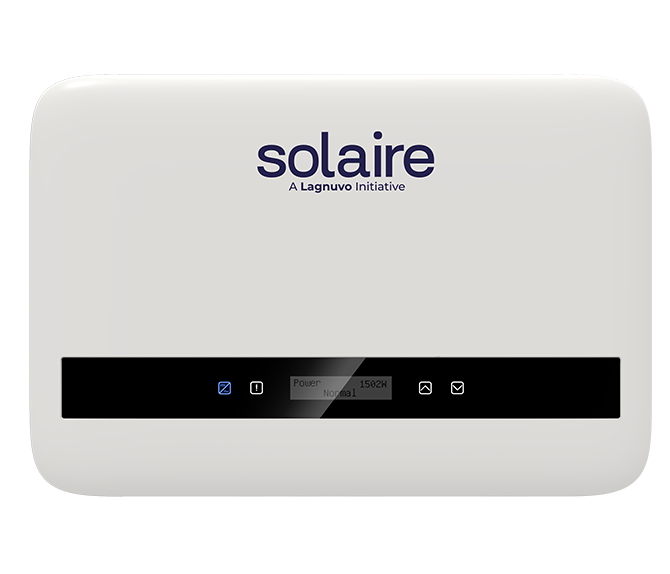

If you have been exploring solar power solutions for your home or business, you have almost certainly come across the term ‘net metering.’ It is one of the most financially compelling reasons to install an on-grid solar inverter in India today. Yet surprisingly few consumers fully understand how net metering works and what role the on-grid inverter plays in making it possible. Solaire is a leading solar solution company and an initiative from India’s established UPS brand Lagnuvo. Solaire develops on-grid inverters designed for Indian grid conditions.
What Is an On-Grid Solar Inverter?
An on-grid solar inverter, also called a grid-tied inverter, converts the DC electricity produced by your rooftop solar panels into AC electricity that matches the voltage, frequency, and phase of the utility grid. Unlike off-grid systems that require solar power batteries for storage, a pure on-grid system relies entirely on the grid as its ‘virtual battery.’ When your panels generate more than you consume, the surplus flows back to the grid. When you need more than your panels produce, you draw from the grid.
How Net Metering Works
Net metering is a billing arrangement with your electricity distribution company (DISCOM) that credits you for the electricity your solar inverter system exports to the grid. Here is the basic cycle:
- Morning to afternoon: Your solar panels generate at their peak. Your 3 kW on-grid solar inverter or larger system powers your home and exports the surplus. The bidirectional electricity meter records units exported.
- Evening and night: Your panels produce little or nothing. You draw from the grid. The meter records units imported.
At billing time, your DISCOM calculates the net difference. This means they subtract the units you exported from the units you imported. You pay only for this net consumption, which can significantly offset your electricity bill, depending on local DISCOM policy.
The Role of the Solar Inverter in Net Metering
Your on-grid solar inverter is the technical heart of a net metering setup. For net metering to work legally and safely, the inverter must have an anti-islanding function. Anti-islanding is a safety mechanism that automatically shuts down the inverter if the grid power fails. This protects utility line workers from accidentally receiving a live current from rooftop solar systems while servicing a downed line. Every Solaire on-grid inverter, from the entry-level Lagnuvo inverter series to the larger three-phase solar inverter models, includes certified anti-islanding protection.
Net Metering Rules Across India
Net metering policy varies by state. Tamil Nadu, Kerala, Karnataka, and Gujarat have well-established net metering frameworks with fast approvals, making them strong markets for solar inverter manufacturers in India and Gujarat. States like Uttar Pradesh and Bihar have historically had slower approval processes, though this is improving. Solar finance companies in India also offer incentivised loan products for grid-tied systems, reducing payback periods in many cases.
Single-Phase vs. Three-Phase Net Metering
For households with a single-phase electricity connection, which covers most urban and semi-urban homes, a single-phase on-grid solar inverter handles net metering seamlessly. Larger homes, commercial establishments, and industrial facilities with three-phase connections require a three-phase solar inverter. Solaire offers both configurations, and both are fully compatible with India’s net metering regulations.
Financial Benefits at a Glance
For a typical 5 kW system in a sunny city like Kolkata or Thrissur, the annual solar generation is roughly 6,500 to 7,000 kWh. At an average grid tariff of Rs. 8 per unit and a favourable crediting mechanism, this translates to potential annual savings of Rs. 52,000 to Rs. 56,000. With Solaire’s solar inverter price points and available subsidies under government schemes, payback periods can fall to 3 to 4 years, depending on tariff, subsidy eligibility, and system performance.
Why the Right Inverter Choice Matters
Net metering transforms your on-grid solar inverter from a simple power converter into a genuine long-term financial asset. By choosing a reliable on-grid solar inverter in India—one with certified anti-islanding, wide MPPT range, and proven grid compliance—you ensure your system qualifies for net metering and delivers consistent returns. Solaire’s range of solar solutions is designed precisely for this purpose, combining technical excellence with the reliability India’s grid conditions demand.

